In 1928, Fats Waller and Andy Razaf penned the jazz standard “Honeysuckle Rose,” and as the Jersey Shore locals behind a plaque commemorating the song’s conception are happy to remind us, the duo did so in an inconspicuous apartment in the coastal town of Asbury Park, NJ.
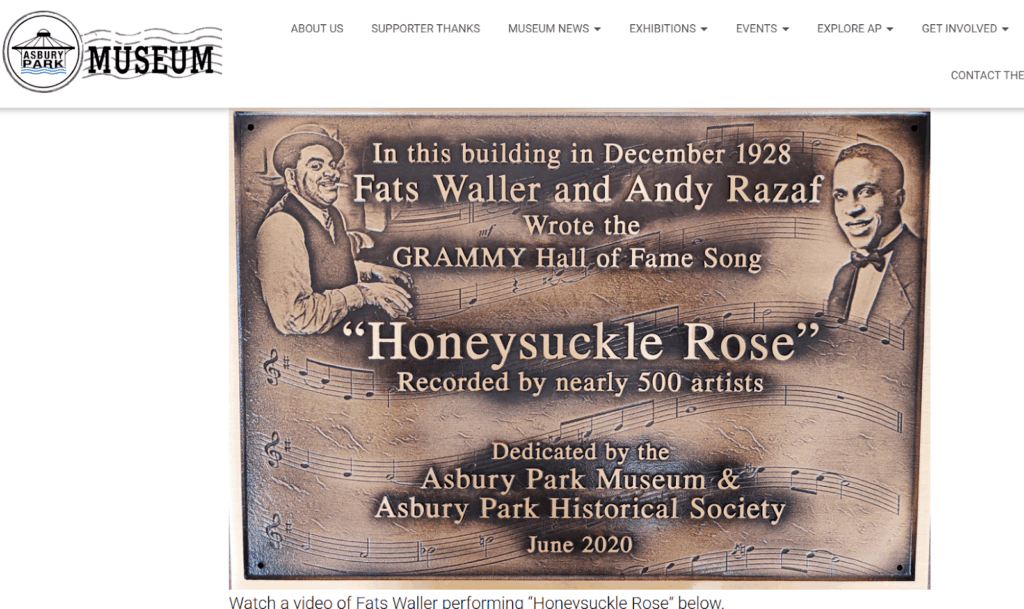
The “Honeysuckle Rose” plaque is a historic marker located at 119 Atkins Avenue in Asbury Park, NJ; a coastal city on the northern half of the Jersey Shore. It was dedicated in 2020 by the Asbury Park Museum and Asbury Park Historical Society to mark the location where pianist Fats Waller and vocalist Andy Razaf wrote the jazz classic “Honeysuckle Rose” in 1928. The plaque is significant because it provides the local community with a physical testament to a real historical connection between Asbury Park and a significant moment in the careers of two influential American musicians. For city residents and visitors alike, it is a reminder that, while the overall narrative of early 20th-century jazz history focuses on New Orleans, Chicago, and New York City; Asbury Park and smaller towns like it have their own stories to tell.
The plaque itself is relatively small, and it does not have the same word count as many historic markers (here, I am thinking of the walls of text one often sees on roadside markers dedicated to Civil War battles). Instead, it makes a concise argument for the significance of the event it commemorates by noting that the song “Honeysuckle Rose” is included in the GRAMMY Hall of Fame, and that it has been “recorded by nearly 500 artists.” It also includes recognizable images of Fats Waller and Andy Razaf, visually centering the site around them and their celebrity. Overall, while the site is not factually dense, it still succeeds in preserving the story it wants to tell: Waller and Razaf were here, and Asbury Park is the birthplace of “Honeysuckle Rose.”
The marker is accessible in person, where it is visible from the sidewalk along Atkins Ave., as well as online, where it is embedded as a .jpg in a page on the Asbury Park Museum’s website: https://apmuseum.org/events/past-events/honeysuckle-rose-plaque-dedication/. The plaque can also be viewed on the Historical Marker Database website: https://www.hmdb.org/m.asp?m=167634. The address of the building where the plaque is located is listed on both of these websites, but a direct Google Maps search for “Honeysuckle Rose plaque” returns no results (I submitted an edit to Google Maps which will hopefully amend this).
The story behind the plaque is expanded upon in the Asbury Park Museum’s website, where readers learn that the second floor apartment of 119 Atkins Avenue was home to Razaf’s mother, and that Waller wanted to stay in Harlem, but was enticed down the shore by the promise of home cooking. We also learn about key individuals and local organizations involved in the plaque’s development and unveiling. Here, we see some of the advantages of digital history as described by Cohen and Rosenzweig in the chapter “Promises and Perils of Digital History” in their 2006 book, Digital History: A Guide to Gathering, Preserving, and Presenting the Past on the Web: for prices much lower than those of erecting physical memorials, historic information can be preserved and disseminated via the internet. The webpage also has the advantage of sharing information not available on the plaque itself. Additionally, it includes a link to a YouTube video of Fats Waller performing “Honeysuckle Rose,” providing the digital audience with a valuable visual and auditory experience inaccessible to visitors of the physical plaque. Lastly, while public monuments like the “Honeysuckle Rose” plaque are intimately tied to their physical locations in terms of message and purpose, digital presentation means that location does not have to limit viewership. Of course, whether or not the average internet-goer will stumble across the Asbury Park Museum’s website is another matter entirely, but for anyone like myself who is actively searching for historical information on jazz, black America, and the Jersey Shore, the internet is quite handy in breaking down barriers of geography.