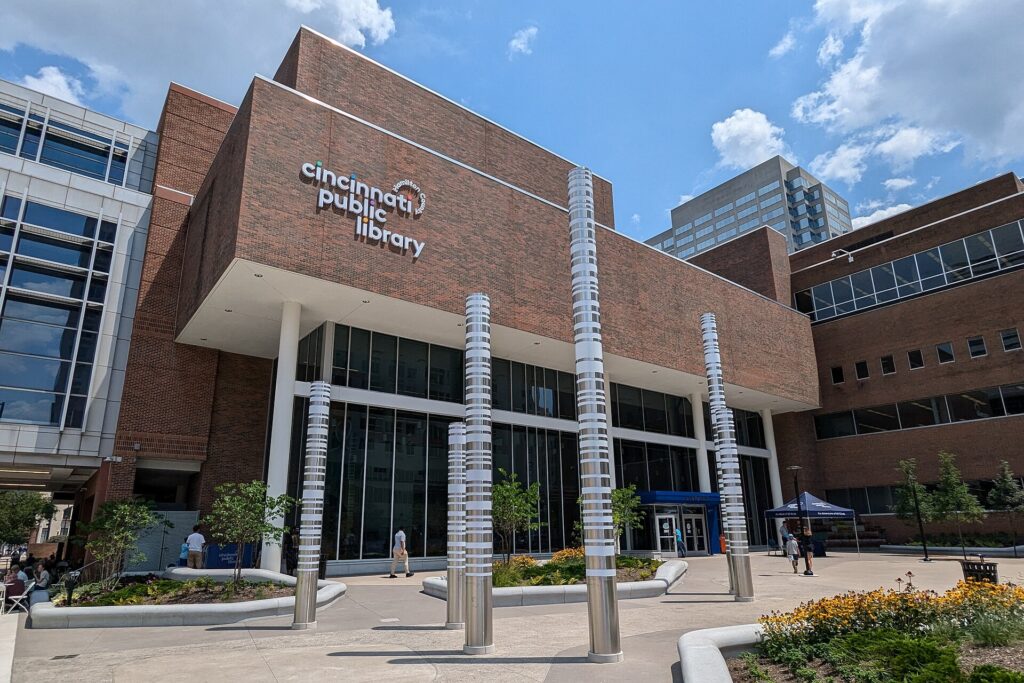
In a blog post for the Cincinnati & Hamilton County Public Library (CHPL), “‘The Negro Motorist Green Book’ Exhibit: Preserving Oral History,” Clarity Amrein calls attention to a one-month special exhibit on the Negro Motorist Green Book presented by the National Underground Railroad Freedom Center, a museum in Cincinnati dedicated to the history of the Underground Railroad and African Americans more broadly. Amrein encourages readers to augment their experiences at the exhibit by accessing digitized versions of the Green Book on the CHPL’s “digital library,” which she links in her post.1 She also highlights the work of the Catherine C. and Thomas E. Huenefeld Story Center at the CHPL, which conducts, archives, and presents oral history interviews. On August 15, 2024, Amrein states that Story Center workers recorded and collected the personal narratives of the speakers at a National Underground Railroad Freedom Center panel called “Vacationing with the Green Book,” where panelists described their experiences of “travel, vacation, migration, and family” as African Americans during the segregated post-WWII era. Embedded in the blog post is a YouTube-hosted montage of the panelists’ interviews. Upon browsing the CHPL’s online collections, it appears that all of the interviews related to the Green Book exhibit are stored on YouTube and catalogued as Streaming Videos. The rest of the Story Center’s oral histories are only accessible in-person through digital kiosks. Amrein calls on readers to contribute their own stories by going to the exhibit and working with the Story Center’s staff, who will be on site at Freedom Center with recording equipment.
In Amrein’s post, it is clear that a digital approach to the humanities has contributed positively to the presentation and preservation of historic information by both the National Underground Railroad Freedom Center and the CHPL. The CHPL’s digital archives allow anyone with internet access to view historic documents with which they might not otherwise have been able to interact. In particular, the digitization of the Green Book is valuable because it is a text which includes information about black recreational travel and the experience of segregation across the country in the 20th century, thereby possessing historic significance to the entire nation. Additionally, by explicitly linking a physical exhibit from the National Underground Railroad Freedom Center to a publicly accessible repository of digital information, the post attempts to merge face-to-face public history and digital history into a cohesive experience which enjoys the benefits of both mediums. Lastly, by adding a call to action for readers to undergo their own oral history interviews, the post exemplifies how the digital humanities has the potential to facilitate contributions to the humanities by people outside of the academic and museum fields.
However, the lack of digitization of most of the oral histories from the Catherine C. and Thomas E. Huenefeld Story Center—save for the interviews conducted in collaboration with the National Underground Railroad Freedom Center—seems to me a limitation on accessibility when evaluating this blog post’s incorporation of DH. Also, the CHPL’s reliance on YouTube to present their Green Book oral histories to the public feels somewhat precarious. However, I am not an archivist and cannot confidently make claims on this subject. Overall, while it is absolutely useful that the entirety of the Story Center’s interviews are preserved digitally and available at the center’s physical location, I would love to see those interviews made viewable/listenable online. That said, perhaps this ‘hole’ in the digitization process is a result of privacy concerns and the specific release forms used by the Story Center. I certainly respect the desire to protect individuals who share very personal stories with public institutions.
- Clarity Amrein, “‘The Negro Motorist Green Book’ Exhibit: Preserving Oral History,” Cincinnati & Hamilton County Public Library Blogs, September 20, 2024, https://chpl.org/blogs/post/the-negro-motorist-green-book-exhibit-preserving-oral-history. ↩︎